When it comes to selecting a countertop, most homeowners focus on color, veining, and finish. But one of the most consequential decisions happens before any of that: thickness. The two standard options: 3cm and 2cm — each bring distinct advantages, and understanding the difference will shape everything from the final look of your space to how the installation itself is approached.
3cm: Premium Look and Durability
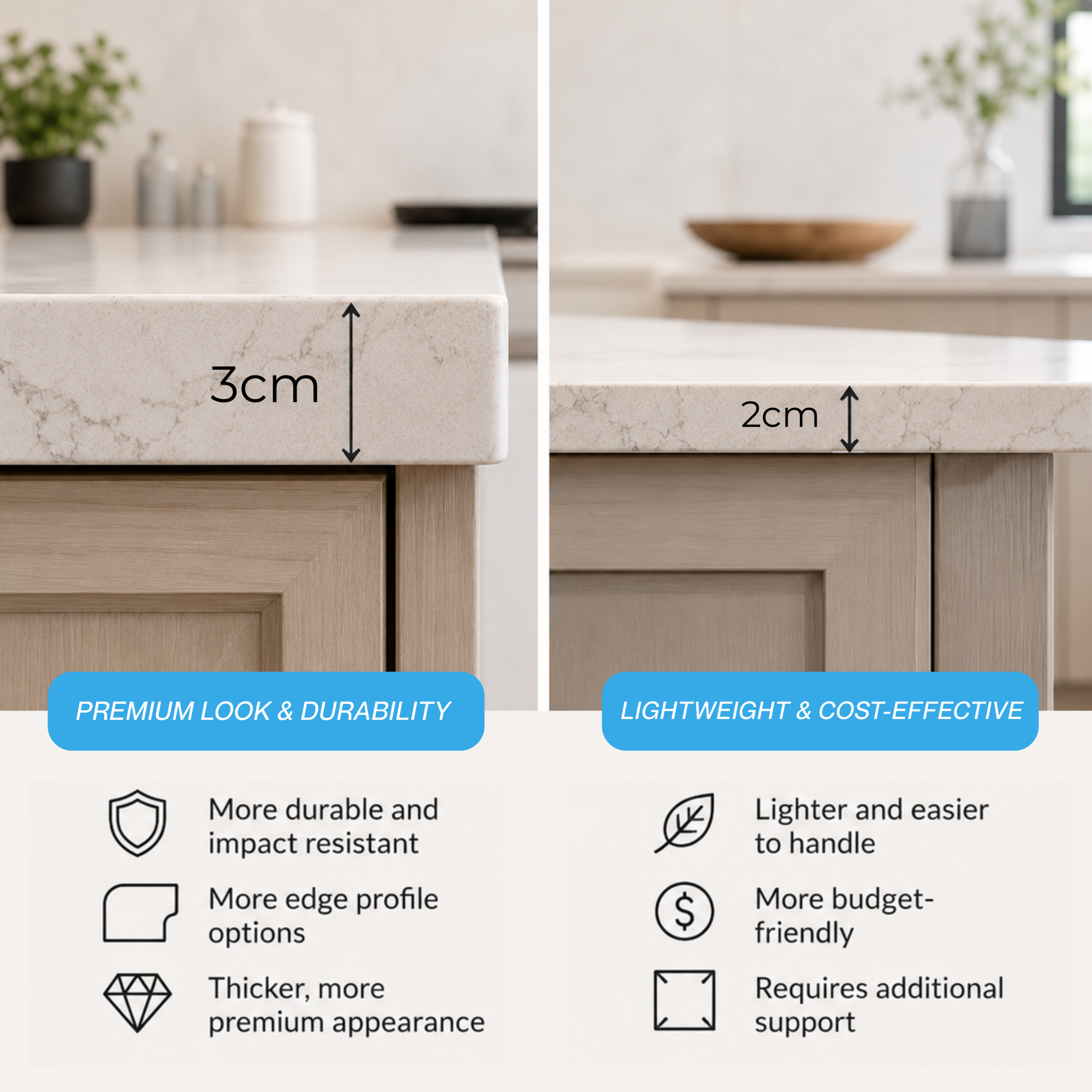
A 3cm slab is the industry standard for a reason. The added thickness gives a countertop a more substantial, high-end presence — the kind of detail that reads as quality the moment you run a hand along the edge.
What 3cm offers:
- More durable and impact resistant. The extra material means greater resistance to chipping, cracking, and everyday wear.
- More edge profile options. Thicker slabs support a wider range of finishes — bullnose, ogee, beveled, and more — giving your design more room to make a statement.
- A thicker, more premium appearance. In waterfall edges and island applications especially, the added depth creates a bolder, more architectural look.
The tradeoff is straightforward: 3cm slabs weigh more, which means cabinetry and support structures need to be built to accommodate that weight, and the material cost is generally higher.
2cm: Lightweight and Cost-Effective
A 2cm slab isn’t a lesser option — it’s a different one, suited to different priorities. For homeowners balancing budget with design, or working on large-format installations, 2cm brings real advantages.
What 2cm offers:
- Lighter and easier to handle. Reduced weight simplifies installation and can open up more layout flexibility.
- More budget-friendly. Less material typically means a lower overall cost, without giving up on the beauty of natural stone or quartz.
- A clean, minimal edge line. For homeowners drawn to a more streamlined aesthetic, the slimmer profile can be the design choice — not just the practical one.
The main consideration with 2cm is support. Because the slab is thinner, proper substrate reinforcement is essential to prevent flexing or sagging over time, and edge profile options are more limited.
So, Which Is Right for You?
Neither thickness is objectively “better” — the right choice depends on three things:
- The application. A heavily used kitchen island may call for the durability of 3cm, while a bathroom vanity or secondary surface may perform beautifully at 2cm.
- The budget. 2cm offers meaningful savings without sacrificing the elegance of natural stone.
- The design vision. From bold waterfall edges to minimalist, low-profile lines, thickness is as much an aesthetic decision as a practical one.
Talk to the Experts
At Allied Gallery, we help homeowners, designers, and builders navigate exactly this kind of decision, before a single slab is cut. If you’re planning a kitchen or bathroom project and want guidance on the right material and thickness for your space, our design studio is here to help.